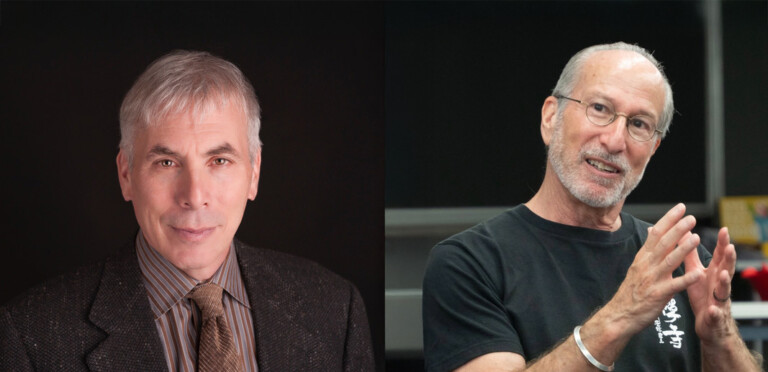
Michael J. Gelb is an authority on the application of genius thinking to personal and organizational development pioneer and is expert at creative thinking, executive coaching and innovative leadership. He is a fifth-degree black belt in aikido and a teacher of tai chi and the Alexander Technique. He is also a professional juggler who performed with the Rolling Stones. He is the author of 17 books—including the international bestseller How to Think Like Leonardo da Vinci—which have been translated into 25 languages and sold more than 1 million copies.
Bruce Fertman brings 60 years of study as a movement artist and educator to his work, having trained in gymnastics, modern dance, ballet, contact improvisation, the Alexander Technique, tai chi chuan, aikido, chanoyu (Japanese tea ceremony), Argentine tango and kyudo (Zen archery). For the past 30 years Fertman has taught in Europe, Asia and the Americas helping people experience the interconnectedness of physical and spiritual life.
Q: What inspired you to write Walking Well: A New Approach for Comfort, Vitality and Inspiration in Every Step?
A: Fertman: I’ve been teaching people how to move well for over 60 years. First, I worked inside of athletics: swimming, diving, gymnastics. Then, I worked for decades with performing artists: dancers, actors and musicians. Then, I worked with physical therapists in Germany and Japan, teaching them how not to injure themselves as they worked with others who had been injured. One day, I realized that the way I could reach the most people and teach them what I know about moving well, would be to do it through teaching walking.
Gelb: Between us, we have been exploring movement education for more than 100 years. We both realized that we could apply everything we’ve learned and help people most effectively by addressing the quintessential human movement: walking. We are inspired to help our readers walk through life with more comfort, energy and inspiration.
Q: What health benefits does walking offer?
A: Walking promotes physical, mental, emotional and spiritual health. The physical benefits are very well-researched. Contemporary science has validated what Hippocrates wrote centuries ago: “Walking is humanity’s best medicine.”
Q: In Walking Well, you recommend taking a baseline reading. Why?
A: So that a person can track their progress. We need to teach people how to sense how they normally walk when they are not thinking about it, that is, their unconscious walk, their habitual walk. As soon as people become aware of how they are moving, straight away they want to be right and so quickly correct themselves. We want them not to correct themselves, not worry about being right or wrong.
That is why we compare a baseline reading to going out and seeing what the weather is like. Weather is not right or wrong. It just is what it is. And it is good to know what it is. Once a person can do this, once they can kinesthetically record their baseline walk, then when they experiment with one of our ideas or images they can do a comparative study.
Q: How long and how far should people walk each day? Why?
A: 7,500-10,000 steps a day is great, of course. But here is a secret. If you are walking 10,000 steps a day poorly, you get really good at walking poorly. But walking poorly is far better than not walking at all. But walking 5,000 steps a day well will give you twice the benefit of walking 10,000 steps poorly. And, walking 10,000 steps well, well, you would not believe how good that is for you until you can experience it.
When walking becomes easier and more comfortable people will walk more because it feels good. Our emphasis is on the quality of every step. Our experience is that when people learn to walk naturally, they just want to walk more so they don’t have to worry about counting their steps because they’ve learned how to make every step count.
Q: What is the difference between “transportational” walking and “transformational walking?”
A: Transportational walking is getting from here to there. Transformational walking is getting from here to really here. We need to know how to do both well.
What if your walk to the grocery store or the bus stop could bring you the same benefits as a walking meditation or a sacred pilgrimage? When you learn to walk well every step becomes a blessing.
Q: In the book, you talk about a number of types of breathing. Talk about them—how are they different, and what benefits do they offer?
A: Fertman: For me, there are two approaches to breathing. A metaphor will help. Some people approach breathing as if they are the musician, and their breathing apparatus is the accordion. Others approach breathing as if they are the accordion, and the world is the breather. In other words, you can learn how to consciously control your breathing and improve it, and some people like working in this way. Other people, like me, like to see what my breathing does on its own if I do not hold it and do not manipulate it. Imagine yourself falling asleep. Close your eyes. Relax your body. Can you feel your breathing begin to happen without you doing it? When you are sound asleep, who is breathing you? So, for me, these are the two main approaches to breathing. Almost all breathing instructors work on conscious breathing. I like teaching people how to be breathed.
Gelb: The most important thing to know about breathing is to keep your mouth closed and allow the air in and out via your nostrils.
Q: What are the four dignities and what role do they play in walking?
A: The four dignities are lying down, (resting), sitting, standing and walking. If you are not rested, you won’t move well. Moving well and resting well are two sides of one coin. After a really bad night’s sleep, you wake up and don’t move as well as you do after a really great night’s sleep.
Now, sitting and standing. What do they have to do with walking? Everyone has a spine, a pelvis, a rib cage and a skull. At any given moment, those three, I call them, spheres are in a relationship to your spine, and to one another. This is true whether you are lying down, sitting, standing or walking. Some spine/sphere relationships are comfortable, flexible, balanced and others are not, are uncomfortable, rigid and unstable. Your habitual spine/sphere relationship in sitting is going to be what you do when you are standing, is going to be what you are doing when you are walking. If you know how to sit with a really comfortable, flexible, integrated, balanced spine/sphere relationship, that will carry over into your standing, which will carry over into your walking. As your spine/sphere relationships become really free and fine, there is a decided feeling of dignity that naturally arises. Our structure is inherently dignified and beautiful.
Q: Is there anything else you would like to add?
A: Walking is the preferred exercise of geniuses in all fields throughout history. Leonardo da Vinci, perhaps the greatest genius of all time, praised the value of walking for inspiration and invented the pedometer! The book is available from your favorite bookseller.
https://walkingwell.com
https://michaelgelb.com
www.graceofsense.com