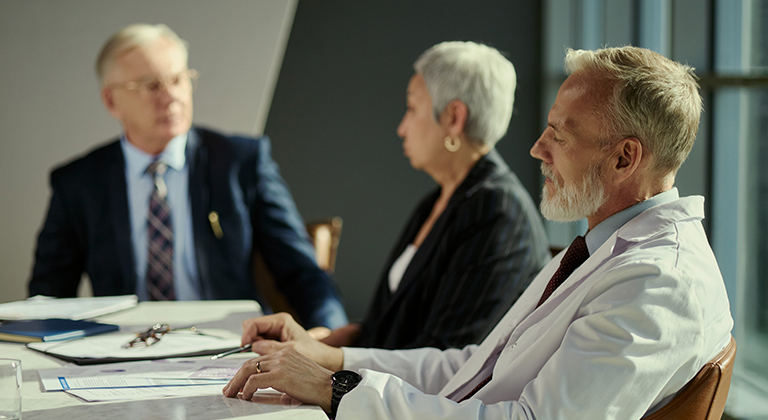
This month, the Institute for Natural Medicine (INM) was invited to a national convening on whole-person care, hosted by the Andrew Weil Center for Integrative Medicine (AWCIM) Oct. 12-14. Wyn Delano, INM’s deputy director, and I joined national health care leaders and experts in research, marketing and public relations for three days of work on a single question: how to make the case for whole-person care in a way the nation can hear.
Finding Shared Language
In his invitation, Dr. Stephen Dahmer, executive director of AWCIM, began with an observation that I share. Across primary care, pediatrics, pharmacy, preventive medicine, research, accreditation, education, advocacy, public health and policy, organizations are already advancing whole-person care. They may describe it differently, but the overlap in their work is far larger than the gaps between them.
The convening’s aim was not to invent a new consensus. It was to name what participants already share, and to say it together clearly enough for policymakers, payers, health systems and the public to hear. People do not collaborate only with those they agree with, but with those with whom they have a relationship strong enough to debate ideas with mutual respect.
The group is working toward a jointly authored white paper and a communications resource for participants, and Delano and I are helping with both.
Representing Practitioners and Patients
We were there in part to help represent our Whole Person Health Action Network (https://naturemed.org/programs/action-network) and the complementary and integrative health (CIH) sector: its licensed practitioners and the patients who seek them out. Also in attendance was Laura Farr from the American Association of Naturopathic Physicians (AANP). We joined leaders involved in primary care, pediatrics, residency training, research and policy from across the conventional healthcare provider community.
I see INM’s role as advancing understanding of three things: what whole-person health is, how whole-person care delivers it, and the value of these approaches to the nation’s health and health economics. Americans have already embraced whole-person health, but the workforce and the payment system have not caught up. Any national conversation about whole-person care needs the practitioners patients are already seeing, and those patients, at the table.
Patients Are Driving Demand
Use of CIH approaches has nearly doubled over the past 20 years, according to the National Health Interview Survey. In 2022, about 37 percent of U.S. adults, roughly 95 million people, used at least one CIH approach, much of it for pain and chronic disease. That figure excludes dietary supplements, which 58 percent of adults over 20 reported using in 2018.
Most of this care happens out of pocket and outside the patient’s primary care plan. The question is no longer whether patients use whole-person approaches. It is whether that care is coordinated with the rest of their health care.
A Workforce Ready to Join the Team
The people who deliver whole-person care include about 260,000 licensed chiropractors, massage therapists, acupuncturists and naturopathic doctors. This is a sizable workforce already credentialed and regulated by the states. Alongside them, more than 100,000 clinicians have some training through the Institute for Functional Medicine (IFM), more than 10,000 are certified in lifestyle medicine, and about 2,000 physicians are board-certified in integrative medicine. Nutrition professionals add depth: nearly 1,500 hold the Certified Nutrition Specialist credential, and more than 4,000 dietetics professionals belong to the Academy of Nutrition and Dietetics’ integrative and functional medicine practice group.
Physician leadership is essential, and the growth of integrative and lifestyle medicine training is an important development within the conventional field of medicine. But delivering lifestyle counseling, manual therapies, mind-body practice and nutrition counseling takes time and follow-up that a 15-minute visit cannot provide. Team-based models allow physicians to bring on board licensed practitioners to deliver care within their scope and more fully address the foundational elements necessary for a whole-person health outcome.
Closing the Knowledge Gap
Team-based care depends on team members who understand and respect one another. Yet conventional health professions training rarely introduces graduates to the full landscape of licensed practitioners who are ready, willing, and able to collaborate in patient care. Clinicians cannot refer to colleagues whose training, scope and evidence base they do not know.
INM’s Whole Person Health Certification course (https://naturemed.org/whole-person-health-course), co-developed with Georgetown University, is designed to close that gap. The 24-credit course gives conventional and integrative clinicians a shared foundation in what whole-person health is, who delivers it, and how those practitioners can work together. It is a practical first step toward the trust and fluency that team-based care requires.
The Value to the Nation’s Health
One of the best, and most urgent, examples of this need is pain care. The American College of Physicians recommends non-drug options such as acupuncture, massage, spinal manipulation and yoga as first-line treatment for low back pain. Coordinated access to that care supports opioid stewardship, reduces risks from unsupervised supplement use and fragmented care, and aligns with value-based payment goals.
A working model already exists. The Veterans Health Administration’s Whole Health program integrates chiropractors, acupuncturists and massage therapists into care teams at national scale. Elsewhere, coverage remains a patchwork: Medicare covers acupuncture for chronic low back pain, yet licensed acupuncturists cannot bill for it directly.
The gap is also an equity issue. Americans spent $28.3 billion out of pocket on these approaches in 2012. People who can pay get whole-person care; those who cannot are more likely to have fewer choices beyond a prescription alone.
Looking Ahead
I see the emerging coalition as a chance to unite a constituency far larger than any single profession: more than 260,000 licensed practitioners, the physicians who lead whole-person care, and the tens of millions of Americans already using these approaches. Payment models will need to change. But reform follows evidence of demand and demonstrated value, and that case is built by educating clinicians, coordinating care and measuring outcomes. Together, this alliance can help move whole-person care from a cash-pay niche to a coordinated, covered part of how the nation delivers health.
I am grateful to Dr. Dahmer and the Andrew Weil Center for bringing this group together. INM looks forward to contributing to the work ahead and ensuring the complementary and integrative health community’s practitioners and patients are not only part of it, but are key to helping shape it.
Michelle Simon, PhD, ND, President & CEO, Institute for Natural Medicine
In 1992, the leadership core of naturopathic doctors established the Institute for Natural Medicine (INM) as a not for profit organization dedicated to advancing natural medicine. The purpose of the INM is to increase awareness of, broaden public access to, and encourage research about natural medicine and therapies. Among its milestones the INM counts the launch of the Association of Accredited Naturopathic Medical Colleges (AANMC) as an independent organization, leading California’s efforts to obtain licensure, developing an interactive childhood education program focused on healthy eating and lifestyles called Naturally Well in 2017, and expanding residency access by establishing and funding a residency program in 2018. INM has joined forces with the American Association of Naturopathic Physicians (AANP), serving as the charitable arm, to deepen access to naturopathic care, public education and research. Dr. Michelle Simon serves as president and CEO of INM, is a licensed naturopathic physician, clinician, educator and leader in many organizations dedicated to improving the quality and delivery of health care. In addition to holding a naturopathic doctorate from Bastyr University, she also holds a PhD in Biomedical Engineering from the University of North Carolina at Chapel Hill. Dr. Simon has served on the boards for the Integrative Healthcare Policy Consortium (IHPC), the AANP and the Naturopathic Physicians Research Institute (NPRI). Dr. Simon also served nine years on the Washington State Health Technology Clinical Committee which is part of the Health Technology Assessment program that examines the scientific evidentiary basis for efficacy, safety and cost effectiveness of health care technologies. She was also an invited participant for health care economics at “Summit on Integrative Medicine and the Health of the Public” at the Institute for Medicine (IOM) in 2009. Dr. Simon was recognized as the 2018 Physician of the Year by the AANP. Twitter: #inaturemed Facebook: @INMWeAreNaturalMedicine